
Search

Animation

BA/BSc (Hons) Animation

YOUR DREAM CAREER IN ANIMATION IS ONLY LIMITED BY YOUR IMAGINATION
Available at
Belgrade
Fees
Duration(s)
6 Trimesters Full Time (Fast Track)

Complete your course faster by studying through 6 trimesters across 2 years.

BA/BSc (Hons) Animation
Course Durations
6 Trimesters Full Time (Fast Track)

Complete your course faster by studying through 6 trimesters across 2 years.

Start Date(s)
Belgrade
  • May 2026

    September 2026

BA/BSc (Hons) Animation
Start Dates
Belgrade
  • May 2026

    September 2026

Entry Requirements
BA/BSc (Hons) Animation
Domestic Entry Requirements
Both domestic and international students must meet one of the following criteria:
Completion of a Senior Secondary Certificate of Education (your Year 12 certificate) or equivalent; OR at least 21 years old and demonstrated experience.
English language certificate (IELTS, TOEFL, any CEFR certificate) showing B2 level competence.
BA/BSc (Hons) Animation
International Entry Requirements
Both domestic and international students must meet one of the following criteria:
Completion of a Senior Secondary Certificate of Education (your Year 12 certificate) or equivalent; OR at least 21 years old and demonstrated experience.
English language certificate (IELTS, TOEFL, any CEFR certificate) showing B2 level competence.

YOUR CAREER IN ANIMATION BEGINS NOW

Course Structure

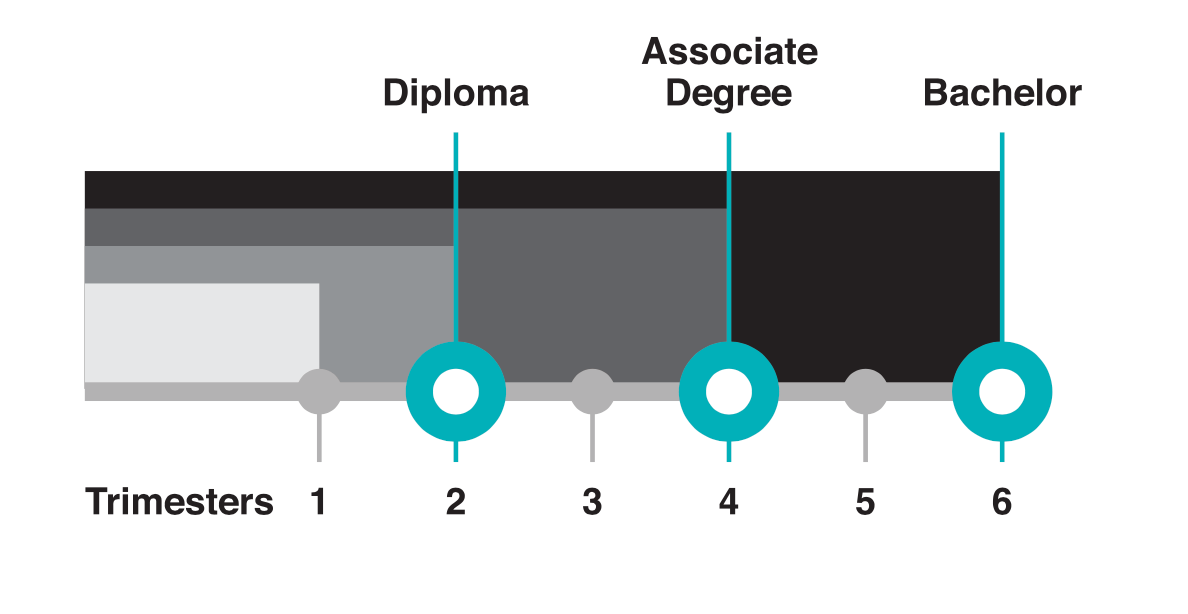
The BA/BSc (Hons) Animation is broken up into three distinct stages over six trimesters (full time, fast track).
Each stage is designed to develop different skills.
Animation Course Structure
Stage 1: Foundations
Develop the essential technical animation skills and the knowledge required to collaborate with other creative media students and professionals.
‘2D Fundamentals’ is the first module leading to the Game Art Animation award. It explores the basics of classical drawing and digital imaging for the creation of 2D assets, introducing students to the workflows and pipelines required. Students also receive a grounding in the conventions of academic writing, and the concepts of intellectual property and copyright in the creative industries.
‘3D Rendering & Compositing’ build from the 3D Fundamentals module to focus on the finishing and implementation of 3D content. Students will learn camera and lighting theory, workflows for rendering and compositing, and also continue to develop their project management skills. Intellectual property and copyright issues will be introduced.
‘Digital Sculpting and PBR Texturing’ addresses the technical aspects of the 3D production pipeline. Lighting, texturing and camera setups for real-time rendered scenes are explored and developed. Students will implement digital sculpting techniques as well as optimisation of geometry, topology and edge flow. Students will also explore techniques for texture baking and develop contemporary workflows using industry standard software packages. This module will introduce students to the necessary skills and knowledge to create digital assets using the same workflow used in the creation of AAA and independent console titles.
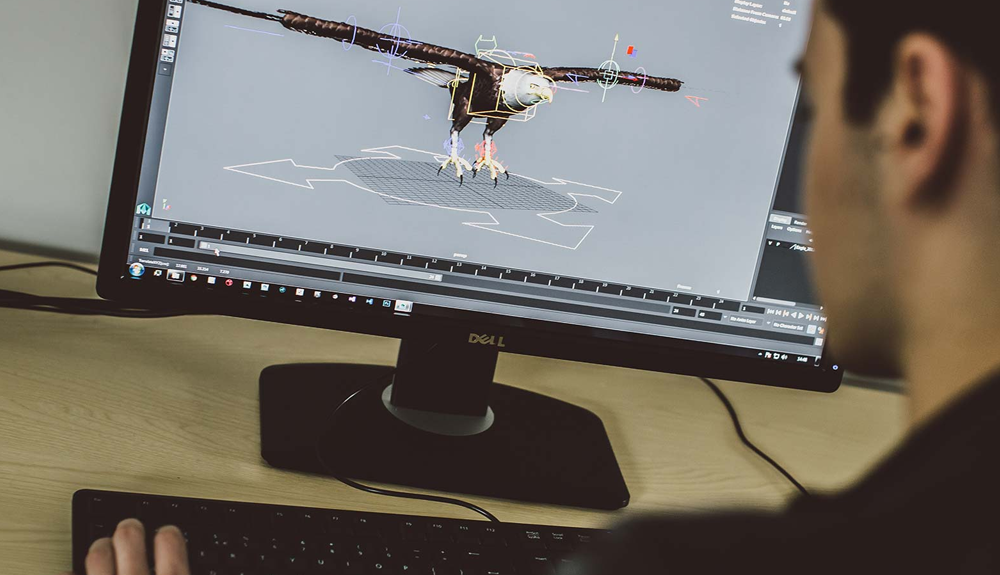
‘Game Art Animation and Rendering’ is the final module in Level 4 for students specializing in Game Art. The module covers the theory and practice of animation and rendering, including technical processes of lighting and rigging. Student will learn about and then demonstrate the relevant techniques through a simple animation. The module provides an insight into the animation process and shows standard workflows in 2D and 3D animation. The result will then be presented in a rendered scene.
Stage 2: Advanced - Refine & Expand
Broaden your scope to work on complex multidisciplinary projects in accordance with industry standard practices.
The module introduces students to professional working environments (or a facsimile thereof), through the ‘Creative Studio’ approach. It builds on foundational skills from Level 4 and introduces students to more advanced professional workflows in their chosen industry. This will include more advanced training in software and hardware, the exploration of complex production techniques, and the student’s ability to critically analyse and reflect on their own work. Students will undertake a number of prescribed projects briefs (the briefs available will be selected by the local campus faculty) led by a facilitator. Students will enhance their creative production skills through these projects, while also developing problem-solving skills, knowledge of cultural contexts, and the ability to engage with constructive feedback.
Creative Studio 2 enables students to contribute their specialised knowledge and skills through assigned roles in collaborative projects, to mirror industry practices in light of its convergence and creative interdependency. Students will build their essential abilities to plan and work in teams, as well as to contribute to extended projects incorporating a business perspective by considering individual strengths. The module also develops students' knowledge and skills in creative media business, equipping them with the tools needed for entrepreneurial working or involvement in creative studio business and marketing roles.
This module enables students to identify an area of professional interest and undertake research to develop a deep and sound knowledge in that area. The research undertaken should be comprehensive and consider the historical development/context of the topic area, existing research in the field, and relevant common production techniques. Throughout this module students will work towards developing the proposal for a Major Project. From the first draft of the research proposal they will develop a more detailed document, supported by broad scholarly research and a feasible methodology. Students will be supported to identify methodologies and outcomes appropriate for either an arts or sciences major project. At the end of this module students will have clearly defined the parameters of their Major Project and how it fits with their career objectives.
Stage 3: Showcase
Execute a project of your own design which is of a high quality and externally published, with the knowledge to commercialise if you choose. You'll also apply your skills through industry work placement.
The Major Project is the culmination of the undergraduate programme; it gives the student the opportunity to demonstrate their skills in a large scale, advanced level project. There are two options for the Major Project.
There is an expectation that the final deliverable for this programme will be of a calibre such that it demonstrates the student’s capacity to progress into professional practice or postgraduate studies.
UCAS Course Codes
BA/BSc (Hons) Game Art and Animation 6 TRIMESTERS

Why SAE?


Thanks to the fact that our program has three semesters per year, instead of the usual two in Serbia, SAE students are able to complete a three-year, 180-ECTS bachelor’s program in only two years. The entire course is delivered in English, and the final diploma is awarded by our partner university from the United Kingdom (University of Hertfordshire). An SAE Institute diploma is highly respected in the audio industry.

Every student receives ample studio time for independent work, as well as one-on-one mentoring throughout all modules, not only during the final project. In addition, there is always a studio supervisor on duty who can help you solve any problem. This is the only way to become a professional audio producer in just two years.

SAE students begin earning money even during their studies, and after graduation they work all over the world: in studios in London (De Lane Lea), cultural centers (Sheikh Abdullah Al-Salem, Kuwait), concert halls (USA, Germany), Dubai, and various festivals. Many of them run their own production studios locally (such as CUNAMI Studio).

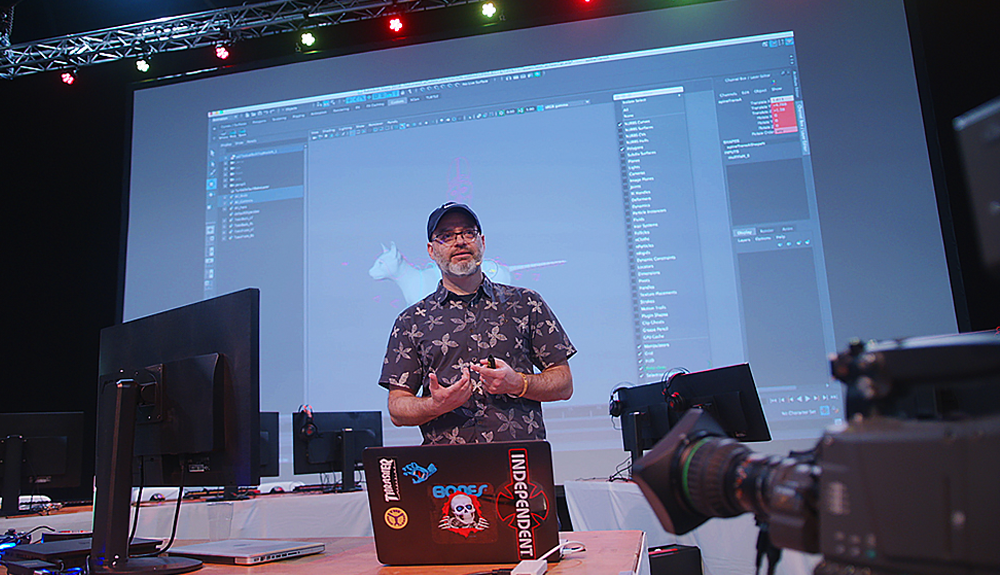
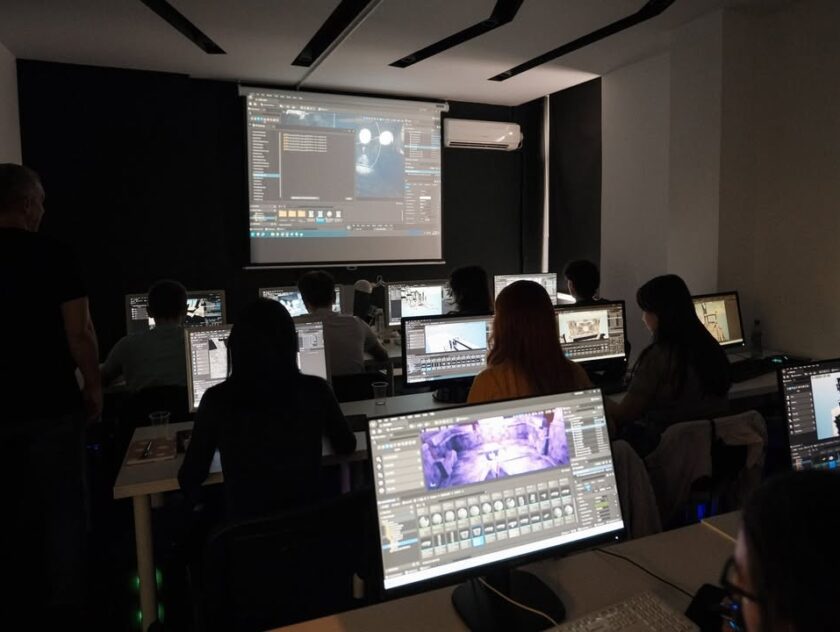
Access to State-of-the-Art Equipment SAE students in the VFX & Animation and Game Art & Animation programs work on advanced, high-performance computers, and the classroom is organized like a “rendering farm,” similar to a production studio environment. Students also have authorized remote access to the rendering farm from home, so they don’t need to stay on campus longer than necessary. Still, they enjoy spending time at the institute — working on both individual and group projects where they learn how to collaborate, just as it’s done in large production studios. - PC workstations equipped with NVIDIA graphics - Rendering farm - iMac computers for project visualization
Partnerships With Leading Industry Names Our partnerships with nearly all major production studios in the gaming and VFX industries — both locally and internationally — are one of our greatest strengths. There is no quality education without real-world application. Our students receive access to equipment and software at the best prices, complete internships at top companies, and have the opportunity to learn from leading professionals through guest lectures and hands-on training. Ubisoft, Eipix Entertainment, Crater Studio, Bunker VFX, Dream Dust Studio, Spring Onion Studio, Fried Studio, Scorn Game (EBB Software), Nordeus, and many others.
With us, to your future job Our lecturers and student coordinator connect and recommend SAE graduates to leading companies in Serbia and abroad, while also helping them prepare for job interviews, build their portfolios, and craft strong CVs. Our hiring partners often say that SAE students stand out because they progress to senior positions much faster than candidates coming from other institutions. We are especially proud that some production studios even offer scholarships to our students.
All SAE Students Worldwide Are Well Connected Our institutes are closely interconnected, giving our students direct access to production companies and studios across the globe.
A Study Program Aligned With Industry Needs The curriculum is designed around the real demands of the VFX and gaming industries, ensuring that after two years of study, students are fully equipped with the skills the market requires. They can easily begin freelancing or secure employment at VFX or gaming studios around the world. They integrate quickly into professional environments because they learn industry workflows during their studies. The production pipeline becomes second nature to them, and the skill set they develop allows them to step directly into production without any additional training.

Student Spotlight

Unreal Day Workshop

Creative Workshop for Beginners (Covering Asset, Layout, Lighting, Lookdev, inematic)
Read more

SAE Belgrade visit to NABA

Read more
INSIDER KNOWLEDGE FROM INDUSTRY PROS

Meet your animation mentors

Gain insider knowledge from trusted experts shaping today’s animation landscape.

Our Partners

Animation skills

3D Generalist 3D or 2D Animator Concept Artist Motion Graphics Designer Storyboard Artist Media Industry Specialist FX Artist Technical Artist 3D Asset Modeler 3D Character Modeler Junior Rigging TD Surfacing Artist Junior Lighting TD Production Coordinator Junior Assembly & Layout Artist Roto Artist Junior Matchmover and Cleanup Junior Compositor

ANIMATION STUDENT WORK

Tools & Software

YOUR ANIMATION CAREER
BEGINS NOW